The Biggest Leadership Mistake You'll Make This Year [035]

Ron Boire
The Development
Three weeks ago, Jack Dorsey cut 4,000 people from Block.
Lead with Purpose - Ron Boire is a reader-supported publication. To receive new posts and support my work, consider becoming a free or paid subscriber.
Forty percent of the company, gone in a Tweet.
His explanation was simple (simplistic?): AI tools now allow a smaller team to do more and do it better.
Yup.
He predicted most companies would follow within a year.
Likely.
The market loved it. Block’s stock jumped 24% overnight. And just like that, a new playbook was born for every CEO looking for a quick win with the board.
Cut headcount. Blame AI. Watch the stock pop.
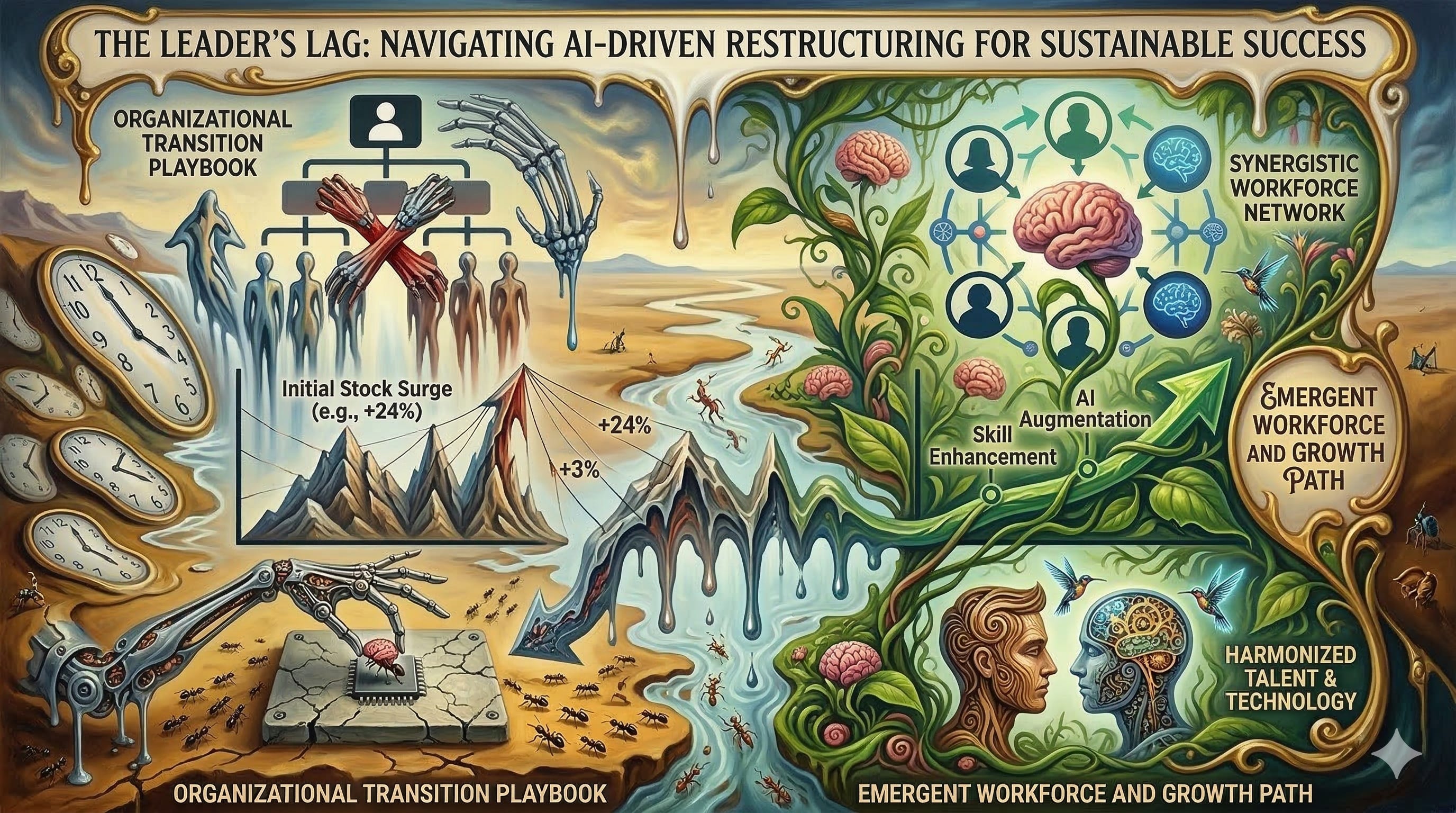
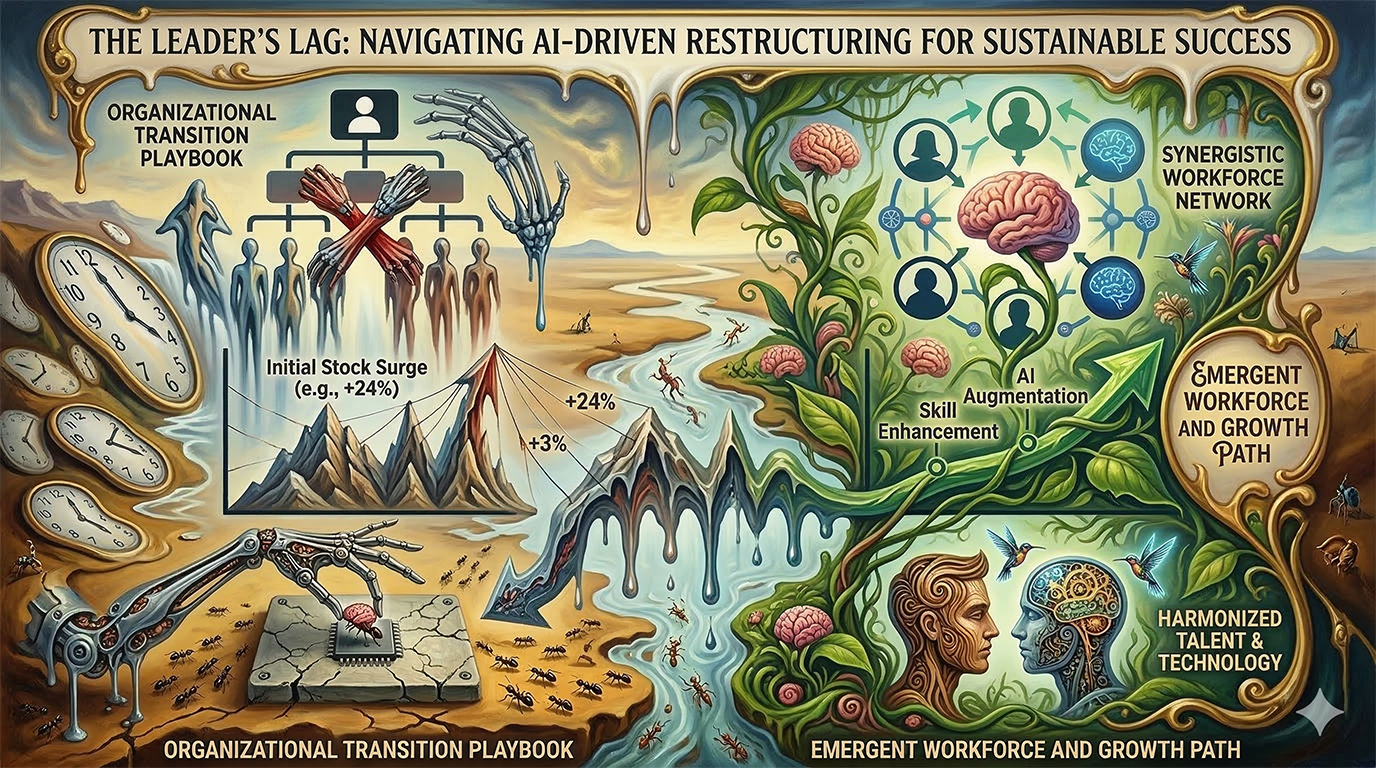
Hey, I have nothing against AI. I use it all the time. I even had AI make this (somewhat) creepy image for this story.
Here’s the problem. It’s the wrong playbook.
While Dorsey was hollowing out his organization, Meta announced plans to cut 20% of its 79,000 employees while investing $135 billion into AI infrastructure. Amazon confirmed 16,000 corporate cuts.
A narrative has taken hold: AI replaces people, people cost money, therefore cut people.
But Jensen Huang, the CEO of the company powering this entire revolution, has a different perspective. His position has been consistent: you are not going to lose your job to AI. You are going to lose your job to someone who uses AI better than you do.
Lots of people, including me, are saying that. Frankly, it’s become trite. Often, I don’t even know what I mean when I say it.
Well, until now.
Three Questions Every CEO Should Ask
Before you tell your CHRO to start modeling headcount reductions, sit with these three questions. They might make you uncomfortable.
First, is this cost reduction or transformation?
Or “AI washing, the practice of dressing up old-fashioned cost-cutting as technological futurism.” As Bloomberg reported. I hadn’t heard the term before, but I like it (I also like “technological futurism,” whatever that is; I’m going to use that one the next time I’m losing an argument).
An Oxford Economics study found that many layoffs CEOs called AI-related were actually corrections for pandemic-era overhiring.
Josh Bersin studied more than 70 companies and found that those who treated AI as a tool to increase individual productivity did not find much real job reduction. The organizations that saw genuine transformation redesigned their work, not their org charts.
There is a difference between eliminating roles and eliminating waste. One requires a spreadsheet. The other requires leadership.
Second, what happens to your institutional knowledge when good people walk out the door?
Every person you cut takes with them years of pattern recognition, customer relationships, and operational judgment that no large language model has been trained on.
In the AI models, they call that “inference.” And it costs billions to recreate.
Huang is warning that the workers who remain will be busier than ever. That only works if the people who remain actually know what they are doing, and don’t spend their days looking over their shoulder for the next cut.
Gut the experience, and you’re left with a smaller team that could be much better at making mistakes.
Third, are you building a company that talented people want to join, or one they want to avoid?
The best people in your industry are watching how companies treat their people.
Salesforce CEO Marc Benioff went the other direction. He thinks today’s CEOs will be the last to lead all-human workforces, he added thousands of sales staff while using AI to increase capacity by 19%. Marc is betting on amplification.
Jack is betting on elimination.
Which company do you think will have the best talent pipeline in 18 months?
One Action
Pick one team in your organization. Sit down with that team’s leader and ask a question: if every person on your team had an AI partner working alongside them, what could they accomplish that they can’t today?
No role elimination.
No headcount reduction.
Just what’s possible when you multiply the talent you already have.
At Shopify, they have a mandate that teams demonstrate why AI cannot handle a task before requesting new hires. Tobi, the CEO, says some employees are now getting 100 times the output with AI tools (not sure I completely buy that, but I get the point). He is not shrinking his company. He is growing his people.
AI is broadening skill requirements in augmentation roles, increasing demand for AI literacy and human-AI collaboration. The World Economic Forum (hold your chirps about the WEF) projects 170 million new roles created against 92 million eliminated, a net gain of 78 million jobs globally.
The future belongs to organizations that amplify their people, not the ones that delete them.
Run the exercise with your team. I guarantee the ideas about what they could do with AI amplifying their work will be more valuable than the headcount reduction in your CFO’s VisiCalc.
The Connection
The reflex to cut is a leadership tell.
It highlights a leader who is reacting to events rather than shaping them.
The hardest question in this moment is not “how do I use AI to do more with less?” It is “Am I a builder, or an optimizer?”
That is not a technology question.
Great leaders build.
Be well,
Ron
(C) 2026 Ron Boire
Related Blogs




Take the first step toward Leading with Purpose™
Whether you need a keynote speaker, executive coach, or strategic advisor, it starts with a conversation about what you're facing and where you want to go.
Most keynotes are booked 3-6 months in advance.
Coaching and advisory engagements typically run 6-12 months and are customized to your needs.