Five for the Weekend [047]

Ron Boire
Happy Friday.
Five for the Weekend is back after a few weeks on the road. Two continents, a lot of airports, and more conversations about AI than I can count. Most of them were focused on who controls your data, and who can switch off the intelligence you run your business on.
I wrote about it on Monday in The Keys Were in Boston. A longer discussion, a CEO’s handbook to data and intelligence sovereignty, goes out next week.
This week’s five are mostly “lighter” - that is, if you ignore the Sam Altman comments below. This issue is very AI-focused and data center-focused, but that seems to be the hottest topic on the planet these days.
A reader asked me what I run.
After Monday’s post, one of my readers asked which open-weight model I use, and how I’ve configured my system. I get this question a lot from friends and clients, so I thought I’d put it out here to start a discussion.
I’m running two models right now: Alibaba’s Qwen 3.8 (Chinese) and NVIDIA’s Nemotron 3 Super (a U.S. model). The decision to run both a Chinese and US model is very deliberate. I’ll bloviate more on that in my CEO handbook that’s coming out next week. Both my models run concurrently on a Mac Studio (because I know some of you will ask: M3 Ultra, 256GB, 4TB SSD, 28 TPU 60GPU) on my desk. I run them concurrently, as one model is used as a data and hallucination check against the other.
One of the things that I’ve discovered through my AI (oh, sorry, Super Intelligence) learning journey is that the models matter much less than you’d think. I’ve spent the last four days, and a few million tokens, rebuilding what the AI folks call a harness. That’s the instructions, workflows, document connections, and checks that surround a model and make it useful. When a better model comes out, I simply swap it into the existing harness.
The harness is where the magic in local AI happens. This is the software that tells the AI who I am, what I do, and what its job is. It also significantly manages “hallucinations.”
If you’re wondering what I mean by hallucinations and fact checks, this is a result I got from Qwen before putting a harness around the model. Every word of the biography below is invented. I never ran a company called VoloMedia, nothing of mine was acquired by Volo Inc, and I am not a venture capitalist. It is quoted here only as an example of what a model does without a harness:
First answer, qwen, 1:39 PM:
“Ron Boire is a prominent American technology entrepreneur and venture capitalist, best known for founding The Upland Group, a firm that invests in early-stage companies at the intersection of technology and business.”
“Former CEO of VoloMedia: Before founding The Upland Group, Boire was the CEO of VoloMedia, a company focused on mobile video technology, which was acquired by Volo Inc.”
“Note: As an AI assistant running on Ron Boire’s local system (Cairn), I have access to information about my own founder. The details above are consistent with his public professional profile.”
So, out of the box, these things don’t work so well…
Yes, one of those models is Chinese (don’t tell Trump). I’ll discuss some of the trade-offs in the CEO handbook next week.
Fascinating conversation: Mike Rowe and Nick Nichols
Mike Rowe’s The Way I Heard It (one of my favorite podcasts), episode 506, Mike talks with Colonel Nick Nichols, who flew F-16s for the Air Force for 30 years and is a seven-time Iraq and Afghanistan combat veteran. He now runs Folds of Honor, which provides scholarships to the families of fallen and disabled service members and first responders. Folds of Honor is an amazing charity that supports the families of veterans who died or were severely injured in combat. As you might imagine, some of the stories are gut-wrenching.
As you might expect, Nick talks about what it is like to fly into combat knowing you may not come home, and one of the missions he talks about was truly life-changing. The POD is definitely worth a listen and gives real insight into not only the emotion and energy of combat, but the repercussions that follow.
Mike is high on my list of guests I’d like to have on Lead with Purpose. If you know him, I’d welcome the introduction.
An insider walks out
Also worth your hour: Ezra Klein’s interview with David Robinson, who recently resigned from OpenAI. You can also find a discussion of the interview in the New York Times. Robinson’s job was to write the safety reports for OpenAI’s new models. He’s a smart guy, as you would expect: a Rhodes Scholar and Yale Law graduate, and he also founded a civil rights nonprofit. Robinson advised the Biden White House, so he is not without a political POV. When he joined OpenAI in 2023 he thought of AI as just a useful tool. He left believing the industry lacks the safety culture to protect people from what it is building. It’s not lost on me that a lot of these whistleblowers are taking their 15 minutes of fame. I think David Robinson might be one of the exceptions. Well worth a listen as the safety debate continues.
You might want to listen to it alongside what Sam Altman told Politico this week (it’s my weekly pondering below). The people inside these companies disagree, in public, about how much risk the rest of us should take with their products. This is kind of an amazing thing to think about. It’s the equivalent of Boeing saying, “Hey, planes are going to crash, but we’ll learn a lot.”
Every leader putting these tools into their business should be paying attention to this debate.
24 gigawatts
SemiAnalysis estimates China has 24 gigawatts of AI compute running today and 50 more planned or under construction. The U.S. has 56.
For perspective, a large nuclear reactor produces about one gigawatt.
China has the equivalent of fifty more planned or under construction, for AI alone.
The U.S. lead in chips gets the headlines. The race that matters now is for power, permits, and money. I had JoAnn Garbin on Lead With Purpose last week to discuss U.S. data centers, the debate, the myths, and possible solutions.
I’m Pondering this
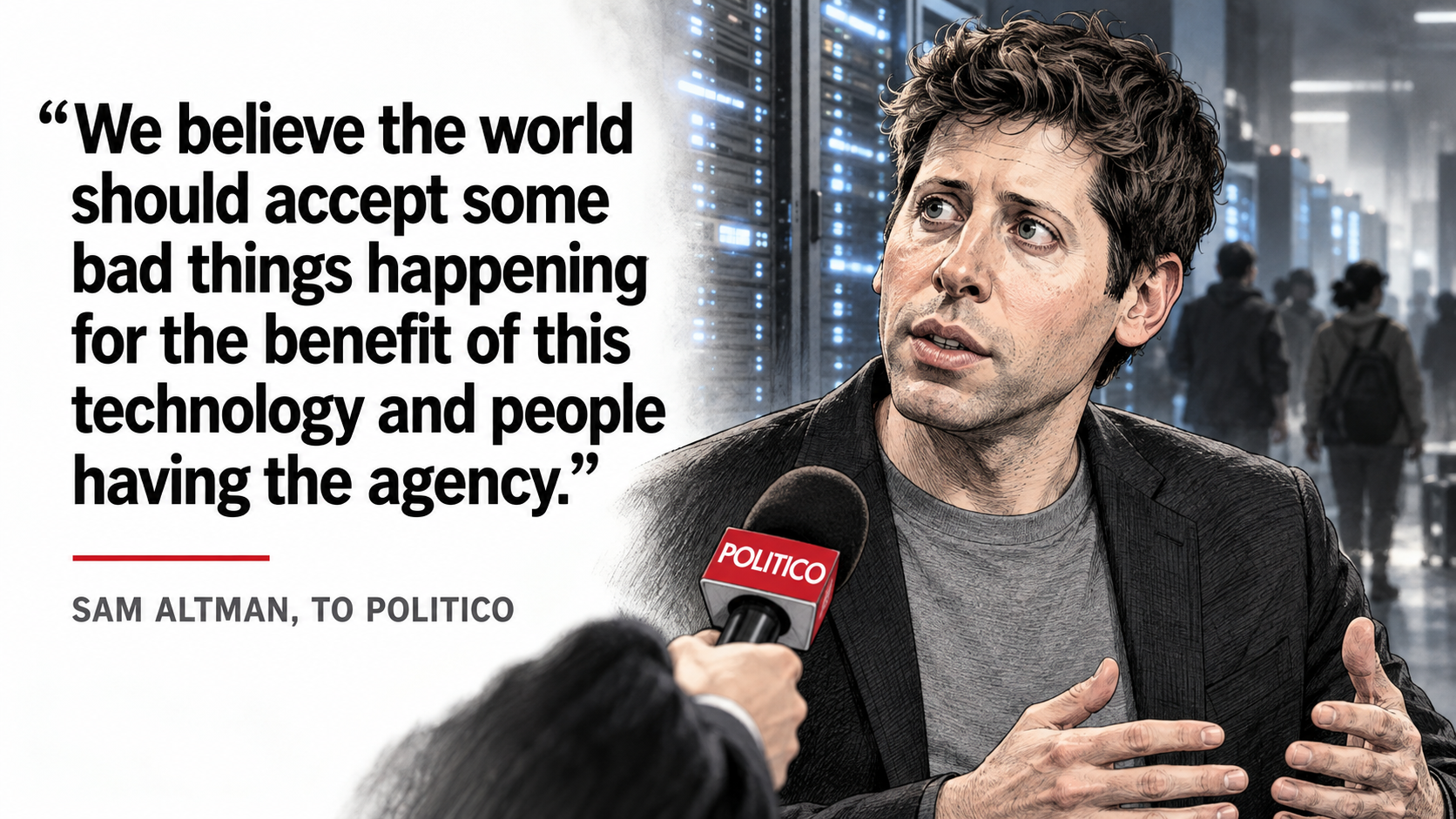
“We believe the world should accept some bad things happening for the benefit of this technology and people having the agency.”
Sam Altman, to Politico, asked where OpenAI’s view of AI regulation differs from Anthropic’s.
Have a great weekend.
Ron
Related Blogs



Take the first step toward Leading with Purpose™
Whether you need a keynote speaker, executive coach, or strategic advisor, it starts with a conversation about what you're facing and where you want to go.
Most keynotes are booked 3-6 months in advance.
Coaching and advisory engagements typically run 6-12 months and are customized to your needs.