Dude, don’t clone me, dude [027]

Ron Boire
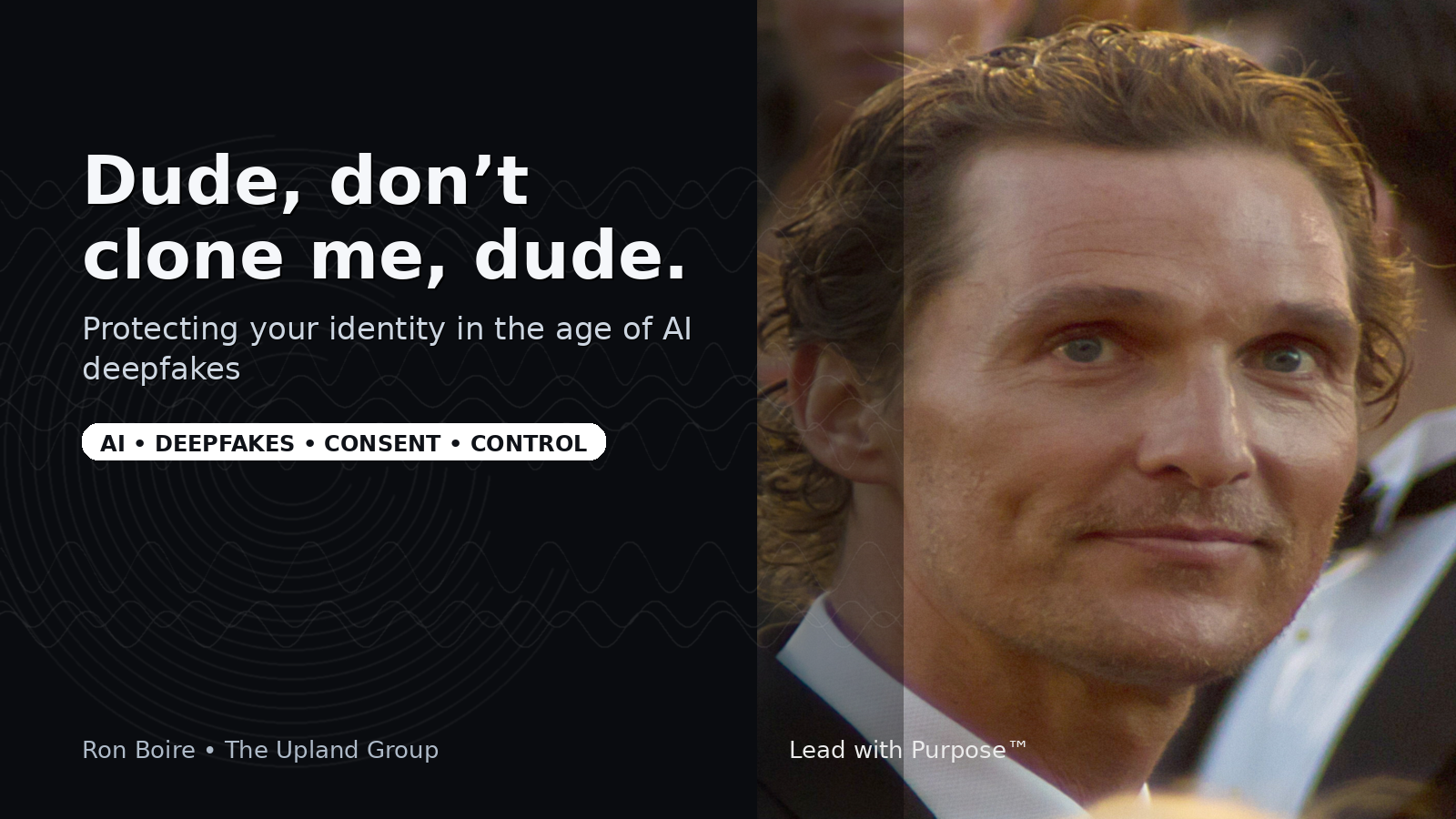
Matthew McConaughey just did something cool. He trademarked himself.
Not his brand or company. Himself. His voice saying, "Alright, alright, alright." Seven seconds of him standing on a porch. Three seconds in front of a Christmas tree. Eight trademarks in total, secured through the U.S. Patent and Trademark Office over recent months.
In doing this, McConaughey may have shown us what the future of personal identity protection looks like.
The Problem We All Face
Here's the reality: AI can now replicate your voice from a few seconds of audio. It can create a video of you saying things you never said. It can place you in contexts you've never been in. And it's getting cheaper and easier every day. Today, AI apps can take a picture of you and make it into a video; these will be so good that your mom won’t know the difference between reality and an AI fake.
To see a simple AI fake take a look at this Instagram post: https://www.instagram.com/reel/DTfvN5GFd7l/?utm_source=ig_web_copy_link&igsh=NTc4MTIwNjQ2YQ==
Now, imagine the possible ways this can be used to manipulate, extort, and steal from all but the most suspicious people!
The ability to protect your likeness must become a protected fundamental right for all of us. The consequences of uncontrolled and unregulated use of our likeness will be too loose control of the very essence of what it means to be you.
State Laws Aren't Enough
Currently, "right of publicity" laws exist in most U.S. states. These laws protect against unauthorized commercial use of someone's name, image, or likeness. But they're inconsistent. They vary dramatically by jurisdiction. Some protect you after death; others don't. Some are statutory; others are common law.
More importantly, they were designed for a pre-AI world. They weren't built to handle deepfakes, voice clones, or synthetic media that can be created and distributed globally in minutes.
McConaughey understood this limitation. State right-of-publicity laws are reactive and fragmented. Federal trademark law offers something different: proactive protection with clear standing to sue in federal court.
The Trademark Strategy
Think of it this way: McConaughey didn't just protect his identity.
By trademarking specific audio and video clips of himself, he created federal intellectual property rights around his identity. If someone uses AI to replicate his voice or likeness without permission, they're not just violating a state publicity law. They're potentially infringing on a federally registered trademark.
That's a different ballgame entirely. Federal courts. Clearer precedents. Potentially stronger remedies.
We all need this without the need to register our humanity. This is a fundamental human right, the right to be “you.”
The Democratization of Identity Theft
AI has democratized the ability to appropriate someone's identity. What once required a Hollywood effects budget now takes a smartphone app and a few minutes. The barriers to creating convincing deepfakes have collapsed.
You don't need to be Matthew McConaughey to be vulnerable. You just need to exist online. A few social media posts. Some videos. Maybe a podcast appearance. That's enough raw material for someone to create a synthetic version of you.
Consider the implications:
• Someone creates a deepfake of you endorsing a product you've never heard of
• A scammer uses your cloned voice to call your aging parents asking for money
• Your likeness appears in content that damages your reputation or career
• An AI-generated version of you says things you'd never say
What's Coming: The Personal Identity Trademark
I believe we're heading toward a future where everyone will have something equivalent to a trademark on their image, likeness, voice, and mannerisms. Not because we're all celebrities. But because we all need protection in an AI-saturated world.
This won't happen overnight. But the trend is clear:
Legislative Action Is Accelerating: In May 2025, the TAKE IT DOWN Act became the first federal law directly regulating deepfake abuse, specifically targeting nonconsensual intimate imagery. The NO FAKES Act, reintroduced in April 2025, would create a comprehensive federal right of publicity for digital replicas. By 2025, nearly every state will have enacted at least one deepfake-related statute.
Technology Companies Are Responding: SAG-AFTRA negotiated AI protections into entertainment contracts. Platforms are implementing detection and labeling requirements. The market for AI-generated content continues to grow, but so does the infrastructure for consent and attribution.
What This Means for You
If you're in a leadership position, this issue is already relevant to you.
Think about the attack vectors:
• A deepfake video of you making statements that tank your stock price
• AI-generated audio of you authorizing fraudulent financial transfers
• Synthetic content that undermines your credibility with stakeholders
• Manipulated appearances that compromise your organization's reputation
The Path Forward
McConaughey's trademark strategy may or may not hold up in court. Legal experts acknowledge this is untested territory. But that's not the point.
The point is that we need new frameworks for protecting identity in an AI world. Trademarking yourself seems unusual today. It might be standard practice in five years.
Here's what I think happens next:
1. Federal standardization: State-by-state patchwork gives way to comprehensive federal legislation establishing clear rights of publicity that explicitly address AI-generated content. Your trade groups and lobbyists should be on this issue now.
2. Registration systems: Just as you can register a copyright or trademark, you'll register your identity biometrics. Your voice signature. Your facial characteristics. Your mannerisms.
3. Consent protocols: Before AI can use your likeness, there will be clear consent requirements, similar to how we handle medical information or financial data.
4. Attribution standards: When AI-generated content uses someone's identity with permission, it will require clear disclosure, similar to how we label sponsored content today.
5. Enforcement mechanisms: Platforms will implement detection systems, and violations will carry meaningful penalties.
The Bigger Question
At its core, this isn't a legal or technological question. It's a human one.
Who owns you?
As we approach the Singularity, this will become an increasingly important issue for all of us.
In a world where AI can replicate your voice, your face, your mannerisms with increasing precision, where do you draw the line? What's the difference between public persona and private identity? Between inspiration and appropriation?
McConaughey is forcing these questions into the courtroom and the public conversation. He's doing what leaders do: seeing around corners, identifying problems before they become crises, and taking action while there's still time to shape the outcome.
Your Move
You don't need to trademark yourself tomorrow. But you should start thinking about how you want to approach this issue.
If you are running a business, talk to your legal team about your organization's exposure, and talk to your trade associations about their plans in Washington. Everyone should consider what protections they might need personally. Watch how the McConaughey case develops. Pay attention to emerging legislation in your state and federally.
Most importantly: recognize that this is coming. The question isn't whether we'll need new frameworks for protecting personal identity in an AI world. The question is what those frameworks will look like and whether we'll help shape them or simply react to them.
McConaughey chose to get ahead of this. That's what leaders do.
We are all working to define what it means to contribute to society and add our unique human value in an AI-driven world. If you would like help thinking about this for you and/or your team, pls reach out, I’d love to talk.
Be well,
Ron
(c) 2025, Ron Boire, and The Upland Group LLC. Lead with Purpose™ and The 51% Rule™ are trademarks of Ron Boire
Related Blogs



Take the first step toward Leading with Purpose™
Whether you need a keynote speaker, executive coach, or strategic advisor, it starts with a conversation about what you're facing and where you want to go.
Most keynotes are booked 3-6 months in advance.
Coaching and advisory engagements typically run 6-12 months and are customized to your needs.